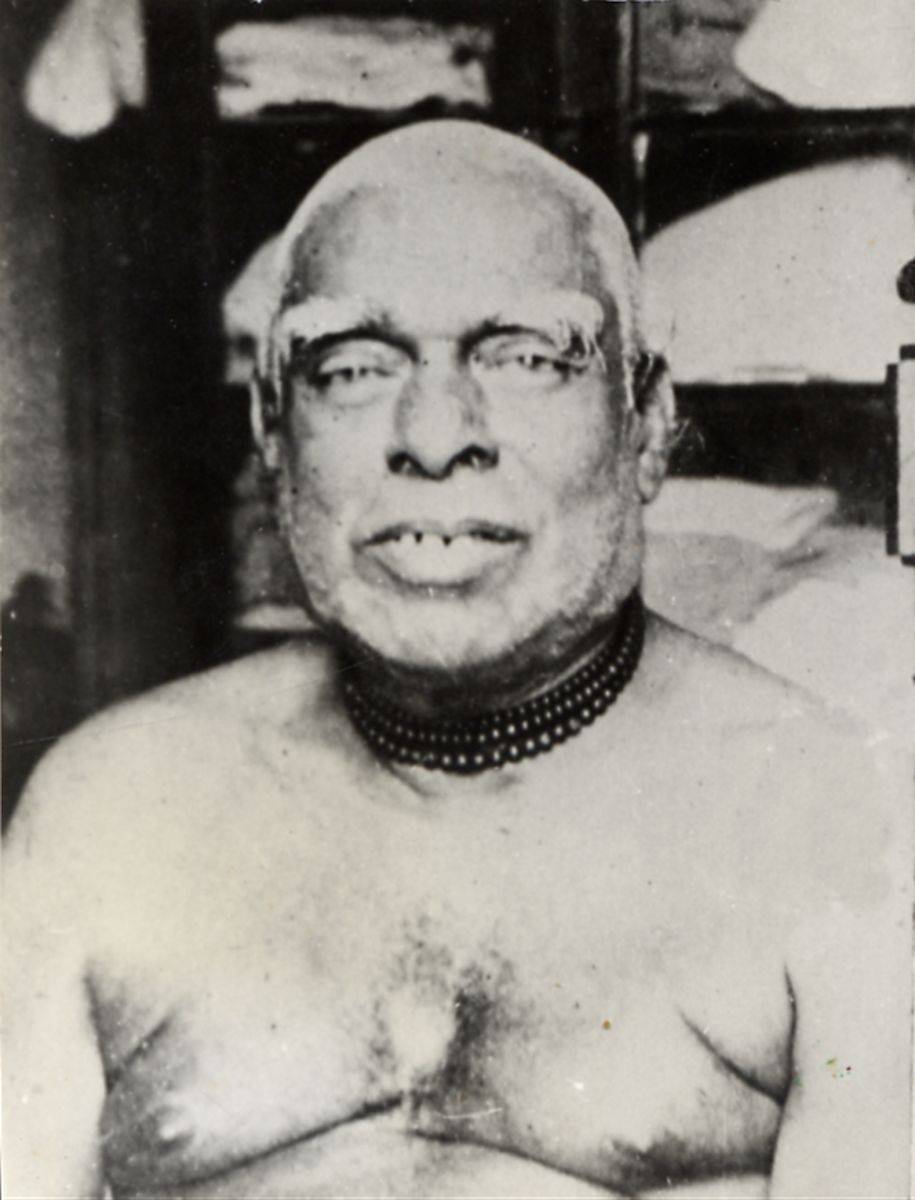
Bhaktivinoda
Ṭhākura
1838 – 1914
Three teachers of the Gauḍīya Vaiṣṇava line
1838 – 1914
Born Kedarnath Datta. A Bengali magistrate, writer and Gauḍīya Vaiṣṇava teacher.
Photograph c. 1910, public domain, via Wikimedia Commons.
Bhaktivinoda Ṭhākura (2 September 1838 – 23 June 1914), born Kedarnath Datta, was a Bengali magistrate, writer and Gauḍīya Vaiṣṇava teacher. He wrote more than a hundred works in Bengali, Sanskrit and English, and is remembered for reviving the teaching of Śrī Caitanya Mahāprabhu in Bengal and for carrying it to readers in the West.
The account below follows his own autobiography, Svalikhita-jīvanī, written in 1896, supplemented by the Wikipedia article on him for his later years. See the note on sources at the end.
1838–1858 · Ula, Calcutta
He gives his birth as the 18th of Bhadra, Śaka 1760 (2 September 1838), in his maternal grandfather’s house in the village of Ula, also called Birnagar, in Nadia. His father was Ānandachandra Datta and his mother Jaganmohinī. He was the third son; his elder brothers and later his younger brothers died, and only his sister Hemlatā survived with him. He studied at the village school, then at Krishnanagar, and was taught English from a young age.
Of his boyhood he writes: “What is this world? Who are we?” These two questions were in my mind when I was ten years old. (Svalikhita-jīvanī, §76.) At twelve he was married to Śyāmamaṇi, who was five. He later went to Calcutta, where he studied, wrote for periodicals and read widely: the Brahmo Samaj, the Bible, the Koran and European philosophy. He knew Dvijendranāth and Satyendranāth Tagore, whom he calls “Baro Dada” (elder brother).
1859–1866 · Orissa and Bengal
He worked as a private tutor, then as a teacher at Cuttack (from 1 September 1859) and Midnapur (from February 1861). His first wife died while their son Annadā was ten months old, and he married again. He then served as a government clerk in Burdwan and Chooadanga. In Midnapur he looked for the Caitanya-caritāmṛta and recorded: “I searched, but could not obtain a copy of the Chaitanya Charitamrita.” (§188.)
1866–1874 · Chapra, Dinajpur, Puri
On 5 February 1866 he was appointed Special Deputy Registrar at Chapra, with the powers of a deputy magistrate. At Dinajpur he became assessor on 17 March 1868. He served at Jagannātha Purī for almost five years from about 1870, in charge of the pilgrim festivals. He studied the Bhāgavata with Gopīnātha Paṇḍita, together with the Ṣaṭ-sandarbha, the Govinda-bhāṣya and the Bhakti-rasāmṛta-sindhu, wrote Datta-kaustubha, and composed many verses of the Kṛṣṇa-saṁhitā. His sons Kamala Prasāda (1872) and Bimala Prasāda (1874) were born there; the second became Bhaktisiddhānta Sarasvatī.
1874–1887 · Narail, Barasat, Calcutta
Posted at Narail for almost three years, he published the Kṛṣṇa-saṁhitā (the autobiography gives the Bengali year 1286, April 1879 to April 1880) and the song book Kalyāṇa-kalpataru (1287, April 1880 to April 1881). A letter about the first from Reinhold Rost in London is dated 16 April 1880; Wikipedia adds that Ralph Waldo Emerson also replied. He and his wife took initiation. Sajjana-toṣaṇī, his Bengali monthly, first appeared in 1881 and ran until 1909. In 1886 Vipina Vihārī Gosvāmī and others gave him the title Bhaktivinoda. In the same year he published Caitanya-śikṣāmṛta. Wikipedia adds that in 1885 he set up the Vaiṣṇava Depository, with a printing press.
1887–1894 · Krishnanagar, Navadwip, Māyāpur
He had wanted to retire to Vṛndāvana, but after a dream telling him to finish his work at Navadwip he was transferred to Krishnanagar on 15 November 1887. At the Christmas break he visited Navadwip. He reports seeing a large building bathed in light across the Ganges, at Ballāldighi, and concluded after inquiry that this was the birthplace of Caitanya. Residents of Navadwip rejected the claim, and the question is still discussed. He wrote Navadvīpa-dhāma-māhātmya and bought land at Surabhi-kuñja in 1888. He began the nāma-haṭṭa preaching programme in 1891–92, and in 1892, after a pilgrimage to Vṛndāvana, established Prapannāśrama with Jagannātha Dāsa Bābājī.
1894–1914 · Surabhi-kuñja and Calcutta
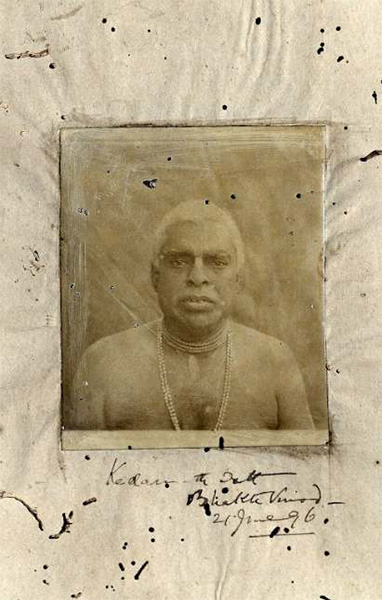
According to Wikipedia he retired from government service on 4 October 1894, aged 56. In 1896 he wrote Jaiva-dharma, the English book Śrīmad Gaurāṅga-līlā-smaraṇa-maṅgala (Chaitanya Mahaprabhu, His Life and Precepts), which he sent to libraries and scholars in Canada, Britain and Australia, and his autobiography. The autobiography ends with a letter to his son Lalita Prasāda dated 21 June 1896. Elsewhere in it, addressing the same son, he writes: “In this world there is no wealth that can compare to the wealth of dharma.” (§302.) In 1908 he took up the life of a bābājī at his house in Calcutta, chanting the Hare Kṛṣṇa mantra until his death on 23 June 1914. His remains were interred at Surabhi-kuñja.
Sources. Svalikhita-jīvanī, English translation by Śukavāk Dāsa, edited by KDA, Internet Archive; section numbers above are that translation’s. Its editor states that he has no access to the Bengali original, that the first translation was rough, and that some passages had to be left out. Several dates in it are inconsistent, so dates here are given only where they are stated clearly. The 1880s publishing details and the years 1894–1914 follow the English Wikipedia article. A draft, to be checked against the Bengali text.
His books are held on the Internet Archive. Most are large scans, so this page links to them instead of hosting copies. The list is not complete: he wrote more than a hundred works.
Titles and descriptions from the Internet Archive listings and the Bhaktivinoda Institute. The Institute reads “Read freely. Reproduce with permission,” so this page only links to it. The periodical Sajjana-toṣaṇī is still to be linked.
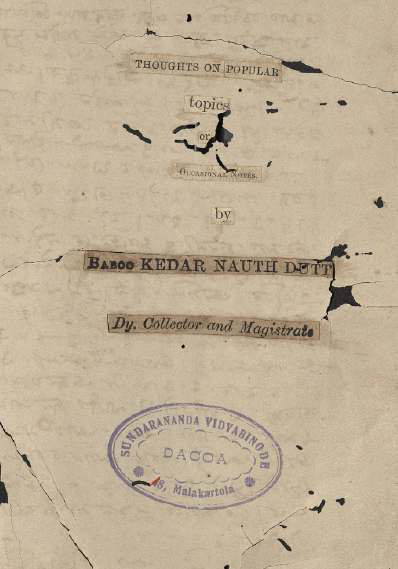
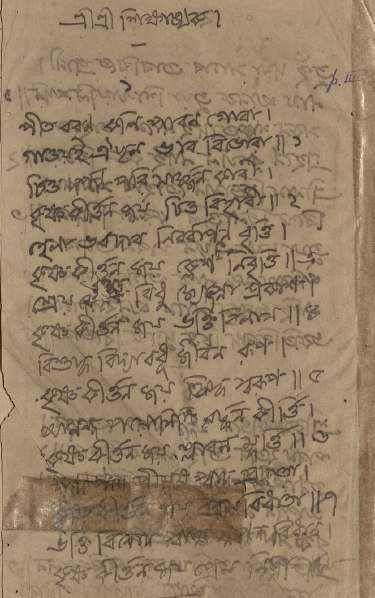
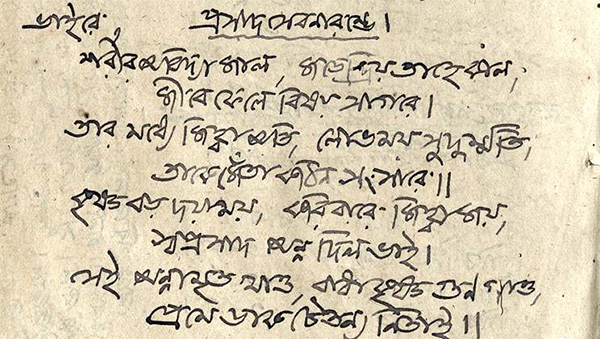
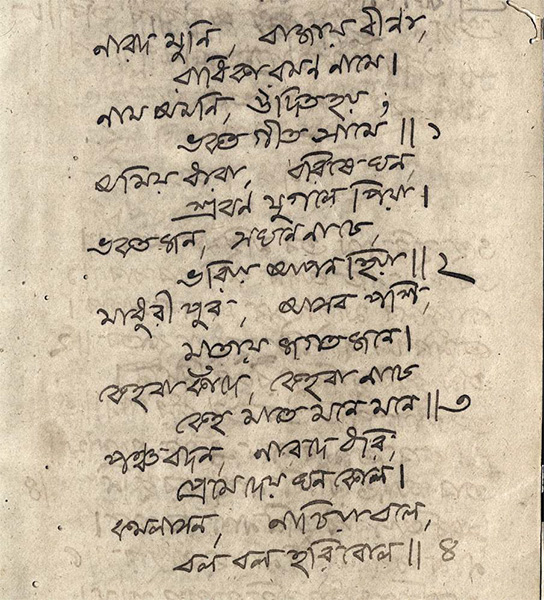
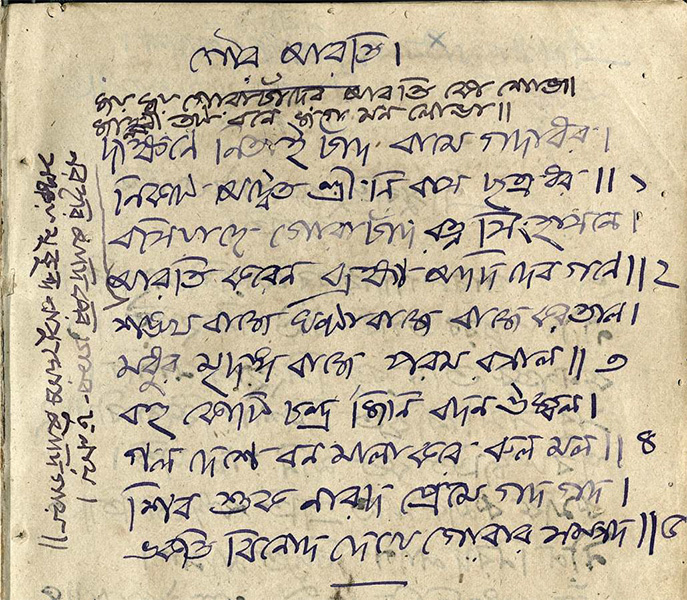
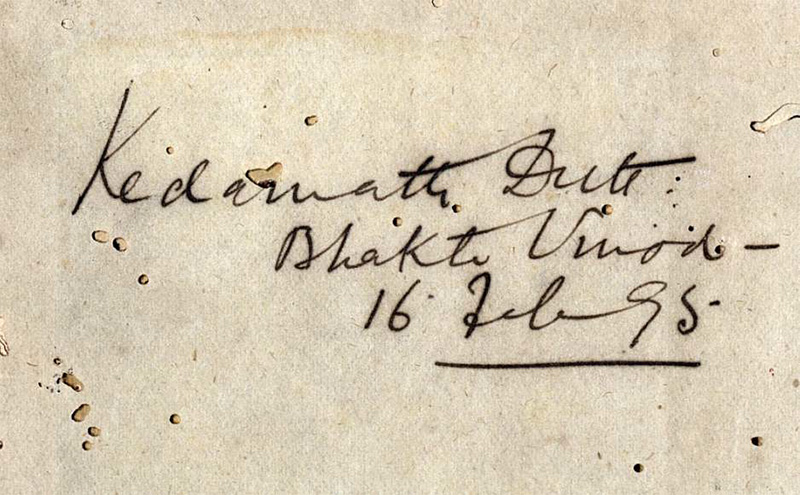
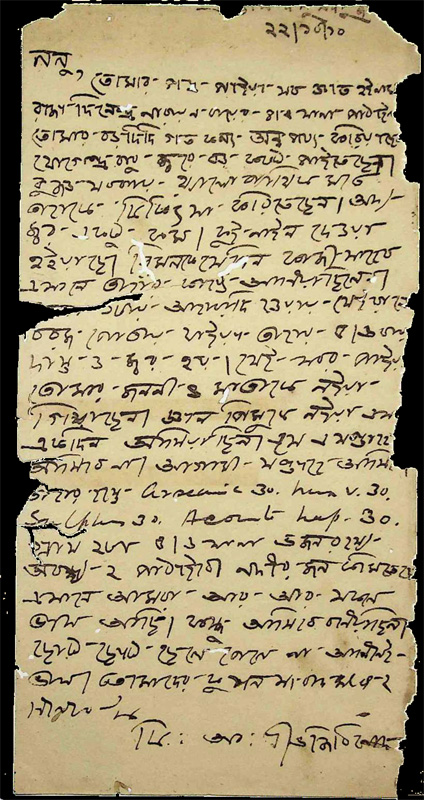
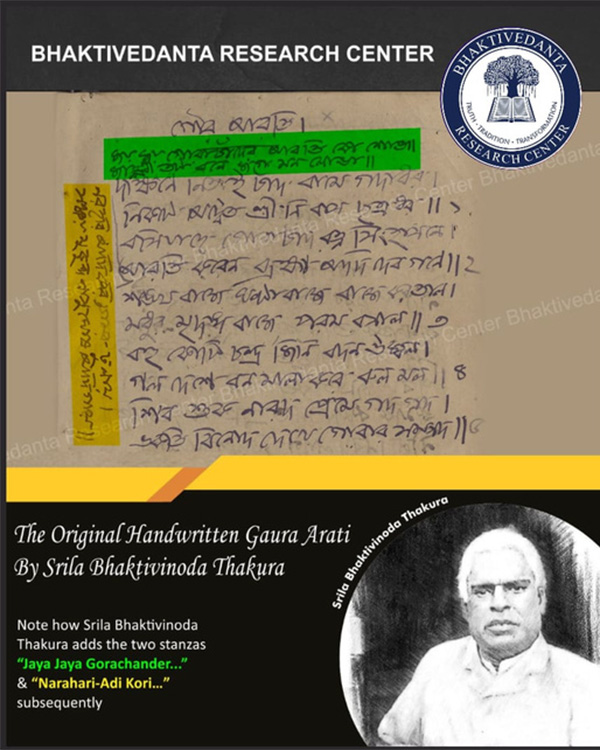
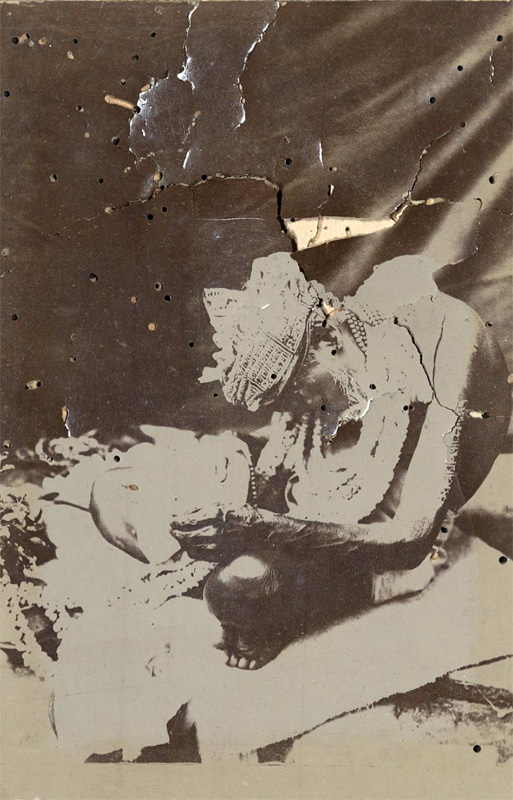
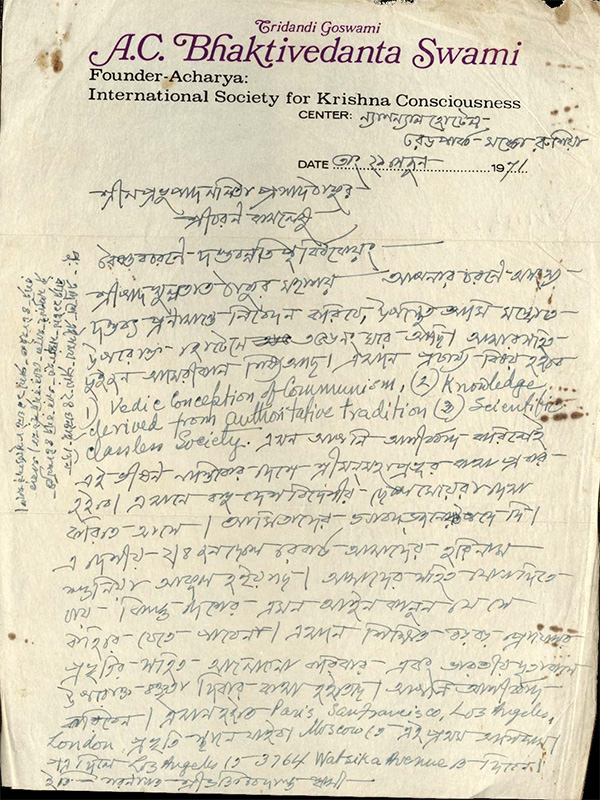
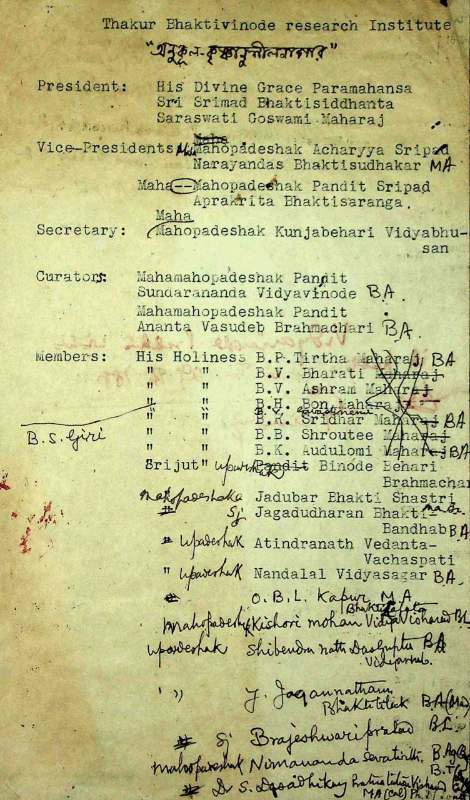
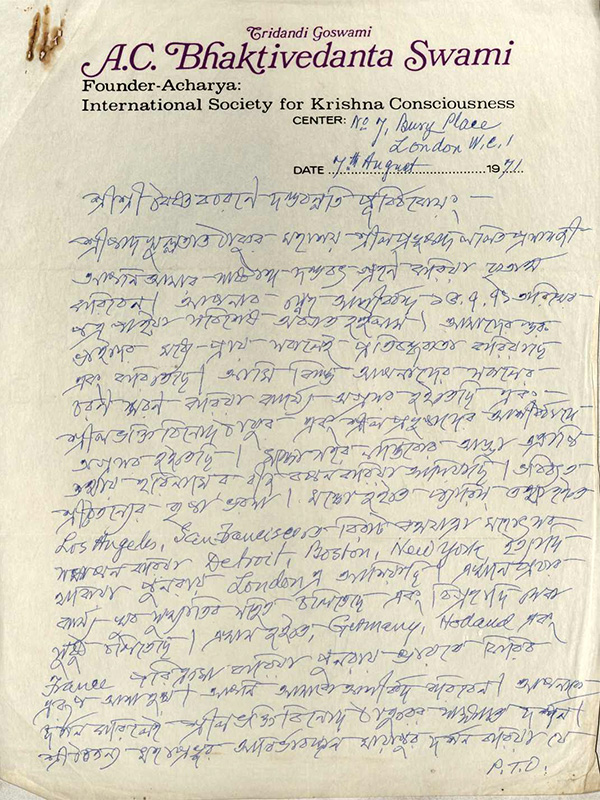
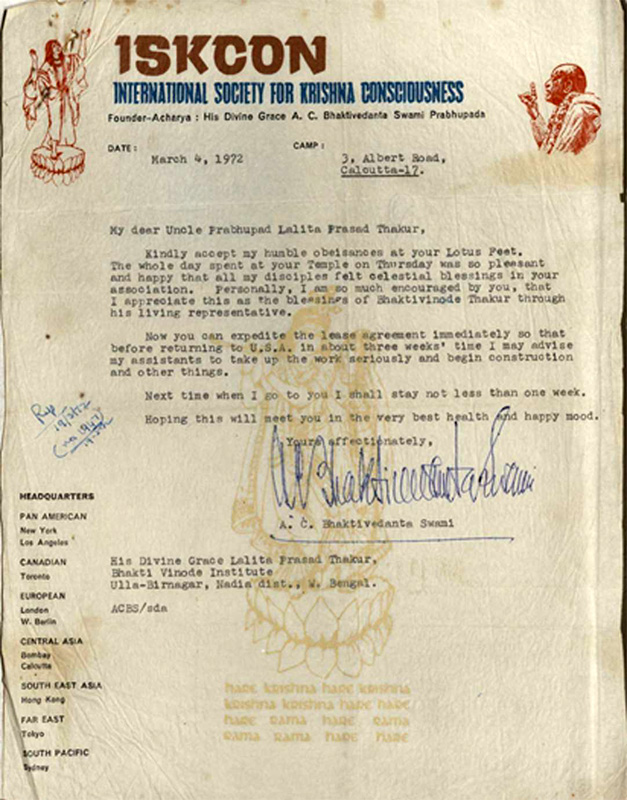
Original documents of Śrīla Bhaktivinoda Ṭhākura and his family, preserved by the Bhaktivedanta Research Center (BRC), Kolkata. Images and descriptions are from BRC’s “Rare Artefacts” collection (brcglobal.org/rare-artefacts).

1874 – 1937
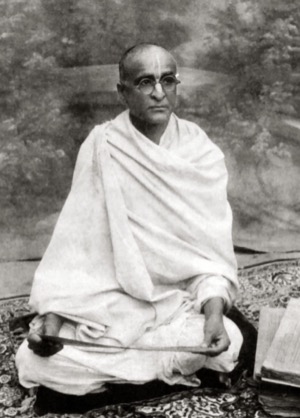
Born Bimala Prasāda Datta. A Gauḍīya Vaiṣṇava teacher and the founder of the Gauḍīya Maṭha.
Photograph published in The Harmonist, 1931, public domain, via Wikimedia Commons.
Draft. This summary follows the English Wikipedia article and has not yet been checked against primary sources. See the note at the end.
Bhaktisiddhānta Sarasvatī Ṭhākura (6 February 1874 – 1 January 1937), born Bimala Prasāda Datta, was a Gauḍīya Vaiṣṇava teacher and the founder of the Gauḍīya Maṭha. He was a son of Bhaktivinoda Ṭhākura, then a deputy magistrate, and Bhagavatī Devī; Wikipedia calls him the seventh of fourteen children, while another biography speaks of ten.
1874–1895 · Puri and Calcutta
He was born at Jagannātha Purī. He studied at Rānāghāṭ, at the Oriental Seminary in Calcutta (1881) and in Serampore (1883), and in 1887 joined the Calcutta Metropolitan Institution, where he studied Sanskrit, mathematics and jyotiṣa. The title “Siddhānta Sarasvatī” is said to date from this period; another biography ties it to his book on the Sūrya-siddhānta. He attended Sanskrit College and left it in 1895 after a dispute with the principal.
1895–1908 · Tripura
In 1895 he became secretary and historian at the court of the king of Tripura, Bīra Candra Māṇikya, and from 1896 to 1908 he tutored the princes under Rādhā Kiśora Māṇikya.
1901–1918 · Initiation and early preaching
In January 1901, according to his own testimony as Wikipedia reports it, he accepted Gaura Kiśora Dāsa Bābājī as his guru and was initiated; another biography puts it at age twenty-six, which would be 1900, and scholars differ on the exact nature of the initiation. In 1904 he travelled in South India to study Vaiṣṇava traditions. From 1905 he gave public discourses and gathered a following among educated Bengalis. On 8 September 1911 he presented a paper on the eligibility of brāhmaṇas and Vaiṣṇavas (Brāhmaṇa o Vaiṣṇava) at the Balighai conference in Midnapore. In 1913, according to Wikipedia, he set up the Bhāgavat-yantra printing press in Calcutta; another biography dates a “Bhagwat Press” to 1915, at Krishnanagar. Bhaktivinoda Ṭhākura died on 23 June 1914 and Gaura Kiśora Dāsa in 1915.
1918–1937 · The Gauḍīya Maṭha
In March 1918 he took sannyāsa, conferring it on himself before a picture of Gaura Kiśora Dāsa, and the name Bhaktisiddhānta Sarasvatī Gosvāmī. In December 1918 he opened his first centre, the Bhaktivinoda Āsana in North Calcutta (Ulṭāḍāṅgā). The movement was registered on 5 February 1919 as the Viśva Vaiṣṇava Rāj Sabhā and came to be known as the Gauḍīya Maṭha, a name the page dates to 1920. In 1927 he launched an English-language periodical. In 1933 senior disciples travelled to London, and the Gauḍīya Mission Society was inaugurated there on 24 April 1934. By the end of his life the Maṭha had sixty-four centres in India and three abroad: London, Berlin and Rangoon.
His disciples included Bhakti Hṛdaya Bon, Bhakti Rakṣaka Śrīdhara and A. C. Bhaktivedanta Swami, who founded ISKCON in New York in 1966. He died on 1 January 1937. He did not appoint a successor; he told his leading disciples to run the mission jointly, and a succession crisis followed within weeks, after which the movement divided into several branches.
Sources. Bhaktisiddhanta Sarasvati, English Wikipedia. Checked (30 Oct) against the whole article and against one excerpt of Satsvarūpa Dāsa Gosvāmī’s Śrīla Prabhupāda-līlāmṛta on the Internet Archive, which covers few of the dates. Most dates therefore rest on Wikipedia alone, and none has been checked against his own writings. The article is inconsistent about his age at death (62 or 63), so no age is stated here.
His books are held on the Internet Archive. Most are large scans, so this page links to them instead of hosting copies. The list is not complete.
Titles and languages from the Internet Archive listings. In the titles of these collections, “Prabhupāda” means Bhaktisiddhānta Sarasvatī himself, as it does in Gauḍīya Maṭha usage; it does not refer to Śrīla A. C. Bhaktivedanta Swami Prabhupāda. “Prabandhāvalī,” “Vaktṛtāvalī” and “Patrāvalī” are translated here as “essays,” “lectures” and “letters.” Each description beyond the title still needs checking against the book itself.
1896 – 1977
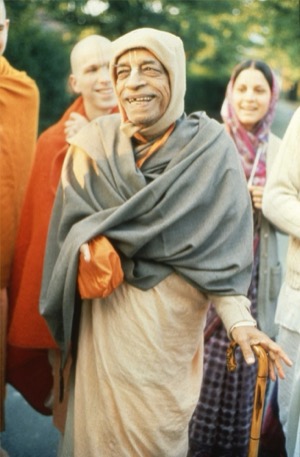
Born Abhay Charan De. The founder-ācārya of the International Society for Krishna Consciousness.
Photograph by Christian Jansen, Germany, June 1974, CC BY 3.0, via Wikimedia Commons.
Draft. This summary follows the English Wikipedia article and has been compared, where possible, with his own letters and conversations on vedabase.cc. It has not been checked against a full biography. See the note at the end.
Śrīla A. C. Bhaktivedanta Swami Prabhupāda (1 September 1896 – 14 November 1977), born Abhay Charan De, was a Gauḍīya Vaiṣṇava teacher and the founder-ācārya of the International Society for Krishna Consciousness (ISKCON).
1896–1922 · Calcutta
He was born in Calcutta on 1 September 1896, the day after Janmāṣṭamī according to Wikipedia. His parents, Gour Mohan De, a cloth merchant, and Rajani De, were Gauḍīya Vaiṣṇavas; in a letter he calls himself the third son of a family of gold merchants. Wikipedia says he began studies at the Scottish Church College in Calcutta in 1916. In his own letter he gives a B.A. in 1920 and says he left his studies in 1921 under the influence of Mahatma Gandhi; Wikipedia says that in 1920 he refused the diploma in protest against British rule. In 1918, while a student, he married Radhārāṇī Datta (“Radharani Devi” in his letter). Both sources speak of five children.
1921–1950 · Business and discipleship
In his letter he says that in 1921 he became assistant manager at Dr. Bose’s Laboratory in Calcutta and then went into the chemical business. Wikipedia says he began a career in pharmaceuticals and later opened his own pharmaceutical company in Allahabad; in a 1976 conversation he says he left Calcutta in 1923 and started his business at Allahabad. Wikipedia and his own statements agree on 1922 as the year he met Bhaktisiddhānta Sarasvatī Ṭhākura, founder of the Gauḍīya Maṭha. Wikipedia names a friend, Narendranath Mullik, as the one who brought him, and reports that Bhaktisiddhānta asked him to spread Caitanya’s message in English; in his letter he says the request was to preach in foreign countries.
According to Wikipedia he had little contact with the Maṭha until 1928, when its sannyāsīs opened a centre in Allahabad, where he was living. In 1933 he received dīkṣā from Bhaktisiddhānta in Allahabad and the name Abhay Charanaravinda (Abhaya-caraṇāravinda); he gives 1933 himself, in his letter and in conversations. Wikipedia adds that he moved to Bombay in 1935 and back to Calcutta in 1937, and that at the end of 1936 Bhaktisiddhānta told him to print books if he ever had money. Bhaktisiddhānta died on 1 January 1937 according to Wikipedia; in the same letter Śrīla Prabhupāda writes 1936.
1939–1959 · Writing and renunciation
The sources differ on when he received the title “Bhaktivedanta.” Wikipedia says that in 1939 elders of the Gauḍīya community honoured him with it. In a 1976 conversation he says that Vaiṣṇava friends gave him the title in 1947 “something,” that is, around 1947. This page does not decide between them.
In 1944 he began the English fortnightly Back to Godhead; Wikipedia and his own letters agree on the year, and Wikipedia says he wrote, edited, financed and distributed it himself. Wikipedia says that in 1950 he took the vānaprastha order and went to live in Vṛndāvana, and that in 1952 he tried to start “The League of Devotees” in Jhansi, which collapsed two years later. In his letter to Mr. Nakano he says he left home for good in 1954; in another letter he says he was a vānaprastha for eight or nine years before taking sannyāsa, which points to about 1950. On 17 September 1959, Wikipedia says, he took sannyāsa at the Keśavajī Gauḍīya Maṭha in Mathurā and received the name Bhaktivedanta Swami. His own letters confirm 1959, but not the day or the place.
From 1962 to 1965, according to Wikipedia, he lived at the Rādhā-Dāmodara temple in Vṛndāvana, where he began translating and commenting on the Śrīmad-Bhāgavatam and produced the first canto in three volumes. A foreword on vedabase.cc, by a disciple who met him in New York in 1966, also mentions three volumes that he had brought from India.
1965–1966 · New York
He sailed on the freighter Jaladuta of the Scindia Steam Navigation Company. Wikipedia gives departure on 13 August 1965 at age sixty-nine and arrival in Boston on 17 September, after a journey of thirty-five days; the foreword just mentioned says he sailed from Bombay to Boston “in September 1965,” which does not agree with a departure in August. Wikipedia reports that he stayed for a time in Butler, Pennsylvania, and then in New York, and opened a storefront temple at 26 Second Avenue. The same foreword places the move to a storefront on Second Avenue in July 1966.
Wikipedia says he incorporated ISKCON in July 1966. Śrīla Prabhupāda himself says in a 1972 conversation that he registered the movement in 1966; the month rests on Wikipedia and on the foreword’s July 1966 move.
1967–1977 · Expansion
Wikipedia reports a second centre in San Francisco in 1967, a London temple opened by disciples in 1968, and visits to Europe, Africa, the Soviet Union (Moscow, June 1971) and India, where he directed his efforts from 1970 to build temples in Bombay, Vṛndāvana and Māyāpur. It says he travelled round the world fourteen times in ten years, opened more than a hundred temples, and initiated nearly five thousand disciples. These figures rest on Wikipedia alone.
Wikipedia says he set up the Governing Body Commission (GBC) in 1970, at first with twelve leading disciples, to oversee ISKCON worldwide; one of his letters from 1970 already mentions it. Wikipedia says he founded the Bhaktivedanta Book Trust in 1972 to manage the publication of his writings; the year rests on Wikipedia alone, and a document of 2 June 1977 on vedabase.cc names him as its settlor.
1977 · Vṛndāvana
He died on 14 November 1977; the date is given by Wikipedia and by the publishers’ notes in his books on vedabase.cc. Wikipedia says he died at the age of eighty-one in his room at the Kṛṣṇa-Balarāma Mandir in Vṛndāvana, after a long illness, and that his samādhi is in the temple courtyard. The place and the age rest on Wikipedia alone. Wikipedia describes a crisis of authority in ISKCON after his death. This page does not go into it.
Sources. A. C. Bhaktivedanta Swami Prabhupada, English Wikipedia, whole article. Compared (30 Oct) with his letter to Mr. Nakano, other letters and conversations on vedabase.cc (for example 10 December 1976, 26 December 1976), and the foreword and publishers’ notes in The Science of Self-Realization. Agreeing with his own statements: birth in Calcutta and 1 September 1896, B.A. 1920, marriage 1918, the 1922 meeting, 1933 initiation, 1944 Back to Godhead, sannyāsa in 1959, arrival in the United States in 1965, ISKCON registered in 1966, passing on 14 November 1977. Different in Wikipedia and in his own words: the year of the “Bhaktivedanta” title (1939 or about 1947), the departure from home (1950 or 1954), Bhaktisiddhānta’s passing (1937 or 1936), and the month of the voyage (August or September). Resting on Wikipedia alone: the day and place of sannyāsa, the dates of the Jaladuta voyage, Narendranath Mullik, Rādhā-Dāmodara 1962–65, the GBC and Book Trust founding years, the figures for travel and initiations, and the place and age at his death. No full biography has been consulted, and none of the dates has been checked in a primary document other than the statements quoted above.
His books are copyrighted by the Bhaktivedanta Book Trust, so this page hosts no text or images from them. It links to the reading text of each book on vedabase.cc. The list is not complete.
These are listed without a synopsis, because the sources used here say nothing about them beyond the title: The Path of Perfection · Perfection of Yoga · The Topmost Yoga System · Perfect Questions, Perfect Answers · Teachings of Queen Kuntī · Elevation to Kṛṣṇa Consciousness · Kṛṣṇa, the Reservoir of Pleasure · Rāja-Vidyā: The King of Knowledge · On the Way to Kṛṣṇa · Life Comes from Life · Beyond Birth and Death · The Science of Self-Realization. His letters and recorded lectures and conversations are also on the site: letters, transcripts.
All of these books are © Bhaktivedanta Book Trust. This page only links to vedabase.cc, which describes itself as a digital edition verified against scans of the original 1972 printings; that description is the site’s own and has not been checked here. The synopses are by the editors of this site, drawn from the English Wikipedia article on him and from the table of contents shown on vedabase.cc, and still need checking against the books themselves. Where a date is given it comes from Wikipedia alone.


